
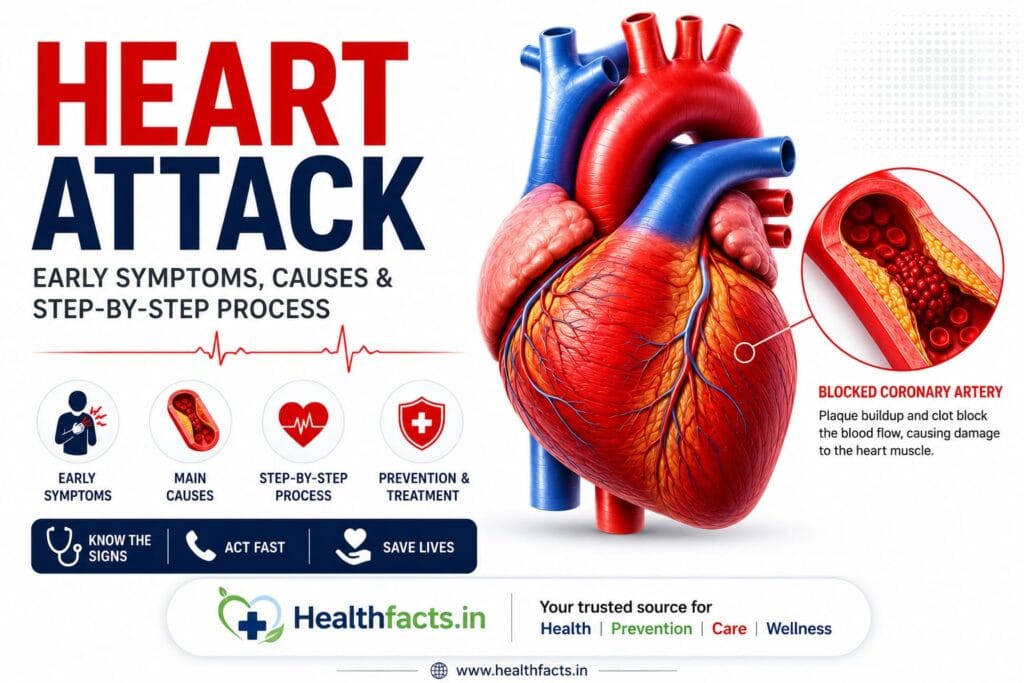
“Heart Attack Early Symptoms, Causes & Step-by-Step Process“
- A heart attack occurs when one or more coronary arteries become severely blocked, leading to a sudden reduction or complete interruption of oxygen-rich blood flow to the heart muscle. 🫀
- This blockage is usually caused by the rupture of a cholesterol-rich plaque, which triggers the formation of a blood clot inside the artery.
- As the oxygen supply decreases, the affected heart tissue begins to suffer damage or die, potentially leading to serious complications if immediate medical treatment is not provided. ⚠️❤️
- A heart attack is also known as Myocardial Infarction (MI).
- “Myo” means muscle 💪
- “Cardial” means heart ❤️
- “Infarction” means tissue damage due to lack of blood flow ⚠️
– The heart needs a constant supply of blood and oxygen to work properly. Blood reaches the heart through special blood vessels called coronary arteries. 🩸
– Over time, these arteries can become narrow because of fat, cholesterol, and plaque buildup. This condition is called Coronary Artery Disease (CAD). 🍔⚠️
– When a plaque suddenly breaks open, a blood clot may form. 🩸
– This clot can block the artery completely, stopping blood flow to the heart.
– As a result:
- The heart muscle does not get oxygen 😰
- Heart cells begin to die 💔
- The heart cannot pump blood properly 🫀
– This is called a heart attack.
1. 🚨 Common Symptoms of a Heart Attack
– A heart attack can cause many warning signs and symptoms. Some symptoms appear suddenly, while others may develop slowly over several hours or even days. ⚠️
– The symptoms can also be different in men and women.
– Knowing these signs early can help save a life. ❤️
😣 Chest Pain or Chest Pressure
– Chest pain is the most common symptom of a heart attack.
– A person may feel:
- Tightness in the chest
- Pressure or heaviness
- Burning sensation
- Squeezing pain
- Fullness in the center of the chest
– The pain usually lasts for more than a few minutes or may come and go. Some people describe it as feeling like a heavy object is sitting on their chest. 🫀
💪 Pain Spreading to Other Body Parts
– Heart attack pain often spreads beyond the chest.
– Pain may travel to:
- Left arm
- Both arms
- Neck
- Jaw
- Shoulders
- Upper back
– This pain may feel dull, aching, or uncomfortable. In some cases, arm or jaw pain may appear before chest pain. ⚠️
😮💨 Shortness of Breath
– A person may suddenly feel breathless or have trouble breathing.
– This can happen:
- During activity 🚶
- While resting 🪑
- Before chest pain starts
-The person may feel unable to take deep breaths or may breathe very fast.
🥵 Cold Sweating
– Sudden sweating without exercise or hot weather can be a warning sign.
– The skin may become:
- Cold ❄️
- Clammy
- Sweaty
– Many people experience heavy sweating during a heart attack.
🤢 Nausea, Indigestion, or Vomiting
– Some people may feel:
- Sick to the stomach
- Nausea
- Vomiting
- Heartburn-like discomfort
– These symptoms are more common in women. Sometimes people mistake them for gas or indigestion. 🍽️⚠️
😵 Dizziness or Lightheadedness
– A heart attack may make a person feel:
- Weak
- Dizzy
- Faint
- Unsteady
– This happens because the heart is not pumping blood properly to the body and brain.
💓 Fast, Pounding, or Irregular Heartbeat
The heartbeat may suddenly feel:
- Very fast
- Uneven
- Fluttering
- Pounding inside the chest
– Some people may feel panic or anxiety along with these symptoms.
😴 Extreme Fatigue
– Feeling unusually tired for no clear reason can be an early sign, especially in women.
– A person may:
- Feel exhausted after small tasks
- Have low energy
- Feel weak for several days before the attack
– This type of fatigue is often ignored but can be important. ⚠️
👩 Symptoms of Heart Attack in Women
– Women may not always have severe chest pain. Their symptoms can be more subtle.
– Common symptoms in women include:
- Shortness of breath 😮💨
- Nausea 🤢
- Back pain
- Jaw pain
- Extreme tiredness 😴
- Mild chest discomfort
– Because these symptoms can seem less serious, women sometimes delay seeking medical help.
2. ⚠️ Causes of a Heart Attack
– A heart attack usually happens when blood flow to the heart becomes blocked. 🚫🩸
– This blockage is often caused by fat, cholesterol, and other substances building up inside the arteries.
– Over time, these deposits form a sticky layer called plaque.
– When the plaque breaks, a blood clot can form and block the artery, leading to a heart attack.
🫀 Below are the most common causes and risk factors of a heart attack :
🚬 Smoking
-Smoking is one of the biggest causes of heart disease.
-The harmful chemicals in cigarettes damage blood vessels and reduce oxygen in the blood.
-Smoking can:
- Narrow the arteries
- Increase blood pressure
- Raise the risk of blood clots
-Even passive smoking can harm the heart. ⚠️
📈 High Blood Pressure
-High blood pressure forces the heart to work harder than normal. Over time, it damages the arteries and makes them stiff and narrow.
-This increases the risk of:
- Blocked arteries
- Heart attack
- Stroke
🧈 High Cholesterol
-Too much bad cholesterol (LDL cholesterol) causes fatty deposits to build up inside blood vessels.
-These deposits:
- Narrow the arteries
- Reduce blood flow
- Increase clot formation
-This is one of the leading causes of heart attack. 🩸
🍭 Diabetes
-High blood sugar damages blood vessels and nerves that control the heart.
-People with diabetes often have:
- High cholesterol
- High blood pressure
- Obesity
-These conditions together greatly increase heart attack risk.
⚖️ Obesity (Being Overweight)
-Extra body weight puts pressure on the heart and blood vessels.
-Obesity is linked to:
- High blood pressure
- Diabetes
- High cholesterol
-Lack of physical activity also weakens heart health. 🛋️
🍔 Unhealthy Diet
-Eating too much:
- Fast food 🍟
- Fried food 🍗
- Sugary drinks 🥤
- Processed food
- Salty snacks 🧂
-can increase cholesterol, blood pressure, and weight gain.
-A poor diet slowly damages the heart and arteries.
🛋️ Lack of Exercise
-Physical inactivity weakens the heart and reduces healthy blood circulation.
-Regular exercise helps:
- Control weight
- Lower blood pressure
- Improve cholesterol levels
-People who rarely exercise have a higher risk of heart disease.
😟 Stress and Anxiety
– Long-term stress can affect the heart in many ways.
Stress may:
- Increase blood pressure
- Raise heart rate
- Lead to unhealthy habits like smoking or overeating
Severe emotional stress may even trigger a heart attack in some people.
🍺 Excess Alcohol
-Drinking too much alcohol can:
- Raise blood pressure
- Damage heart muscles
- Increase weight gain
-Heavy drinking increases the chance of heart problems.
👴 Age and Family History
-The risk of heart attack increases with age.
-People are also at higher risk if:
- Parents had heart disease
- Family members had early heart attacks
-Genetics can play an important role. 👨👩👧
😴 Poor Sleep
-Not getting enough sleep may increase:
- Blood pressure
- Stress hormones
- Risk of obesity and diabetes
-Poor sleep habits can negatively affect heart health over time.
❄️ Cold Weather and Pollution
-Very cold weather can make the heart work harder. Air pollution may also damage blood vessels and increase heart attack risk.
⚠️ Illegal Drugs
-Drugs like cocaine and amphetamines can suddenly narrow arteries and trigger a serious heart attack, even in young people.
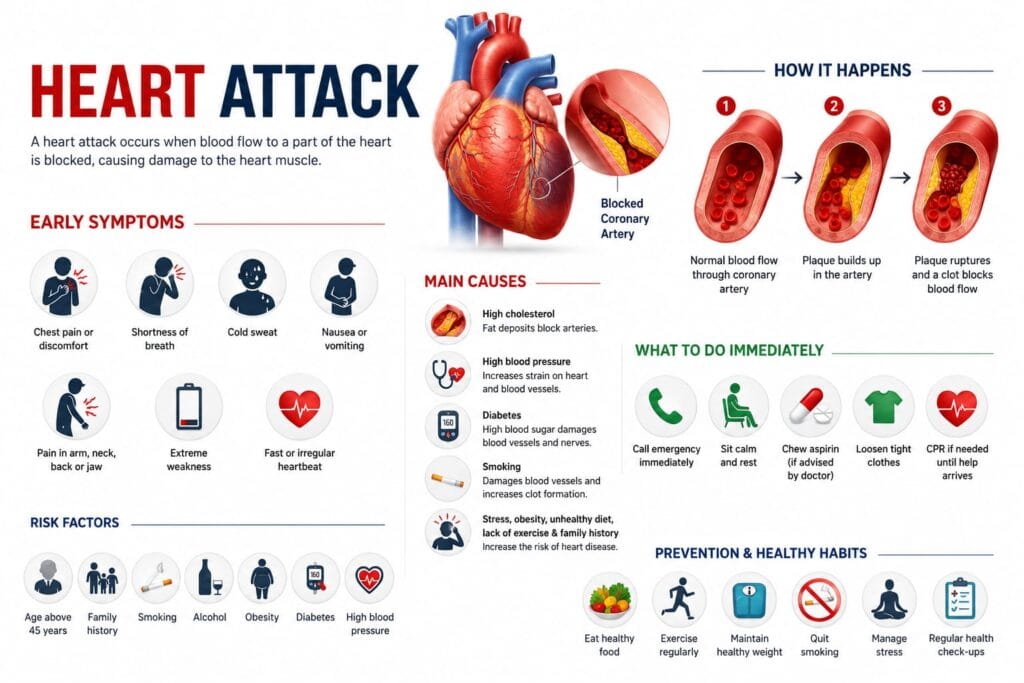
3. Step-by-Step Process of a Heart Attack ❤️⚠️
- A heart attack does not usually happen all at once. It is often the result of a slow process that develops over many years inside the body.
- The arteries that supply blood to the heart gradually become damaged and blocked.
- When the blood flow suddenly stops, the heart muscle begins to suffer from a lack of oxygen.
- Understanding this process can help people recognize warning signs early and seek treatment quickly. 🚨
1. Fat and Cholesterol Begin to Build Up 🩸
-The process often starts with the buildup of fat, cholesterol, and other harmful substances inside the coronary arteries.
-These arteries are responsible for carrying oxygen-rich blood to the heart muscle. Over time, this sticky material forms a layer called plaque.
-Think of it like a water pipe slowly filling with dirt and grease. At first, water can still flow through the pipe, but as the blockage grows, the space becomes narrower.
-The same thing happens inside the arteries. Smoking, high cholesterol, diabetes, unhealthy food, stress, and high blood pressure speed up this damage.
2. Arteries Become Narrow and Hard ⚡
-As plaque keeps growing, the arteries become narrow and stiff. Doctors call this condition atherosclerosis. Blood can still pass through, but not as smoothly as before. The heart now has to work harder to receive enough oxygen.
-During this stage, some people may notice early symptoms such as chest discomfort, tiredness, or shortness of breath while walking or climbing stairs.
-Others may not feel any symptoms at all. This hidden stage can continue for years without warning signs.
3. Plaque Suddenly Breaks Open 💥
-One day, the plaque inside the artery may crack or rupture. This is a dangerous turning point. The body thinks the cracked plaque is an injury, so it quickly tries to repair it by forming a blood clot.
-The clot may become large enough to block the artery almost completely. This sudden blockage stops blood from reaching part of the heart muscle. At this moment, the actual heart attack begins.
4. Blood Flow Stops Completely 🚫❤️
-When the artery becomes blocked, oxygen-rich blood cannot reach the heart muscle. Without oxygen, heart cells begin to die within minutes.
-This causes severe chest pain, pressure, or tightness that many people describe during a heart attack.
-Some people also feel pain spreading to the arm, jaw, neck, shoulder, or back.
-Other symptoms may include sweating, nausea, dizziness, and difficulty breathing. The longer the blockage remains, the more damage happens to the heart.
5. Heart Muscle Gets Damaged 🫀
-If treatment is delayed, the heart muscle becomes weak and damaged permanently. Dead heart tissue cannot heal like normal skin or muscles. This damage can reduce the heart’s ability to pump blood properly.
-In severe cases, the heart may stop beating normally, leading to dangerous complications such as heart failure, irregular heartbeat, or cardiac arrest. This is why doctors always say, “Time is muscle.” Every minute during a heart attack is critical. ⏰
6. Emergency Treatment Restores Blood Flow 🏥
-Doctors try to reopen the blocked artery as quickly as possible. They may use medicines to dissolve the clot or perform a procedure called angioplasty, where a tiny balloon and stent are used to open the artery.
-Quick treatment can save heart muscle and greatly improve survival chances. People who receive fast medical care often recover better and face fewer long-term complications.
👉 Flow chart of Steps :
| Step | What Happens |
|---|---|
| 1 | Fat and cholesterol build inside arteries |
| 2 | Arteries become narrow and stiff |
| 3 | Plaque breaks open |
| 4 | Blood clot blocks blood flow |
| 5 | Heart muscle starts dying |
| 6 | Emergency treatment restores blood flow |
4. Major Risk Factors ⚠️
Several risk factors increase the chance of having a heart attack. Some can be controlled, while others cannot.
| Risk Factor | Why It Is Dangerous |
|---|---|
| Smoking | Damages arteries |
| High blood pressure | Strains the heart |
| Diabetes | Damages blood vessels |
| High cholesterol | Causes plaque buildup |
| Obesity | Increases heart workload |
| Stress | Raises blood pressure |
| Lack of exercise | Weakens heart health |
| Family history | Genetic risk factor |
| Poor diet | Raises cholesterol and sugar |
5. Heart Attack Diagnosis ❤️🏥
-Doctors use different tests to find out if a person is having a heart attack. Quick diagnosis is very important because fast treatment can save lives. 🚑
Common Tests Used to Diagnose a Heart Attack
1. ECG (Electrocardiogram) ⚡
-This is usually the first test. Small wires are attached to the chest to check the heart’s electrical activity. It helps doctors see if the heart is damaged or not.
2. Blood Tests 🩸
-Doctors take a blood sample to check for special proteins called troponin. High troponin levels can mean the heart muscle is damaged.
3. Chest X-Ray 📸
-A chest X-ray helps doctors look at the heart and lungs. It can show if the heart is enlarged or if there are other chest problems.
4. Echocardiogram 🫀
-This test uses sound waves to create pictures of the heart. It helps doctors see how well the heart is pumping blood.
5. Angiography 🏥
-Doctors inject a special dye into the blood vessels and use X-rays to find blocked arteries. If a blockage is found, treatment can start immediately.
6. Best Ways to Prevent Heart Attack 🥗🏃
– The good news is that many heart attacks are preventable. Healthy lifestyle changes can dramatically lower risk. Prevention is always easier and safer than treatment after damage has already happened.
– Regular exercise keeps the heart strong and improves blood circulation. Even 30 minutes of walking daily can make a big difference. Eating healthy foods is equally important. Fresh fruits, vegetables, whole grains, nuts, fish, and healthy oils support heart health.
– Avoid smoking completely because there is no safe level of tobacco use. Limit alcohol consumption and manage stress through meditation, yoga, hobbies, or spending time with loved ones. Sleep is also extremely important because poor sleep increases heart disease risk.
– Regular health checkups help detect high blood pressure, diabetes, and cholesterol early before they cause serious damage. Recent studies show that many heart attack victims had warning signs years earlier that were ignored.
👉 Foods That Improve Heart Health 🍎❤️
– Food acts like fuel for the heart. Healthy food choices can reduce cholesterol, improve blood pressure, and protect blood vessels.
– Some heart-friendly foods include:
| Healthy Food | Benefits |
|---|---|
| Oats | Reduces cholesterol |
| Fish | Rich in omega-3 |
| Fruits | Full of antioxidants |
| Vegetables | Improve circulation |
| Nuts | Healthy fats |
| Olive oil | Supports heart health |
| Green tea | Rich in antioxidants |
7. Final Thought❤️
A heart attack rarely appears without warning. The body often sends quiet signals such as chest discomfort, fatigue, breathlessness, sweating, dizziness, or unusual pain in the jaw and arms. Sadly, many people ignore these symptoms until it becomes too late. Understanding early warning signs and seeking fast treatment can save lives.
Modern lifestyles filled with stress, unhealthy eating, smoking, poor sleep, and inactivity are increasing heart attack risk even among younger adults. The good news is that many risk factors can be controlled through healthy habits, regular exercise, balanced diets, stress management, and medical checkups.
Your heart works every second of your life without taking a break. Taking care of it is one of the best investments you can make for your future. ❤️
8. Medical Disclaimer
This information is only for educational knowledge purpose. It is not a substitute for medical advice, diagnosis, or treatment. Always consult a doctor or qualified healthcare professional for any health concerns.
FAQs ❓
1. What is the first sign of a heart attack?
The first sign is often chest pressure, tightness, or discomfort that may spread to the arm, neck, jaw, or back.
2. Can young people get heart attacks?
Yes. Stress, smoking, obesity, diabetes, poor diet, and unhealthy lifestyles are increasing heart attacks in young adults.
3. How long can heart attack symptoms last?
Symptoms may last for a few minutes or continue for hours. Some warning signs may appear days or weeks earlier.
4. Can a heart attack happen without chest pain?
Yes. Silent heart attacks may cause fatigue, nausea, breathlessness, dizziness, or mild discomfort without severe chest pain.
5. What should I do during a heart attack?
Call emergency services immediately, stay calm, chew aspirin if advised, and begin CPR if the person becomes unconscious.

Hi, I’m Shishpa, founder of Healthfacts.in. I am a passionate health blogger focused on Mental wellness, Diabetes care, Weight management, and natural remedies. My goal is to provide easy, research-based and practical health advice that anyone can follow at home.