
Why Am I Gaining Weight Even When I Eat Less? 11 Reasons
Gaining weight can be confusing, specially when you feel that you are eating less than before. You may wonder, “Why am I gaining weight even though I don’t eat much?” 🤔
The truth is that weight gain is not always about simply eating a lot. Many other things can affect your weight, such as physical activity, sleep, stress, hormones, medicines, food choices, and muscle mass.
Sometimes, you may eat less food but still get more calories than you think. Your weight can also go up because of water retention, constipation, hormonal changes, or changes in muscle, not just body fat.
1. Common Reasons of Gaining Weight Even When Eat Less[Meto]
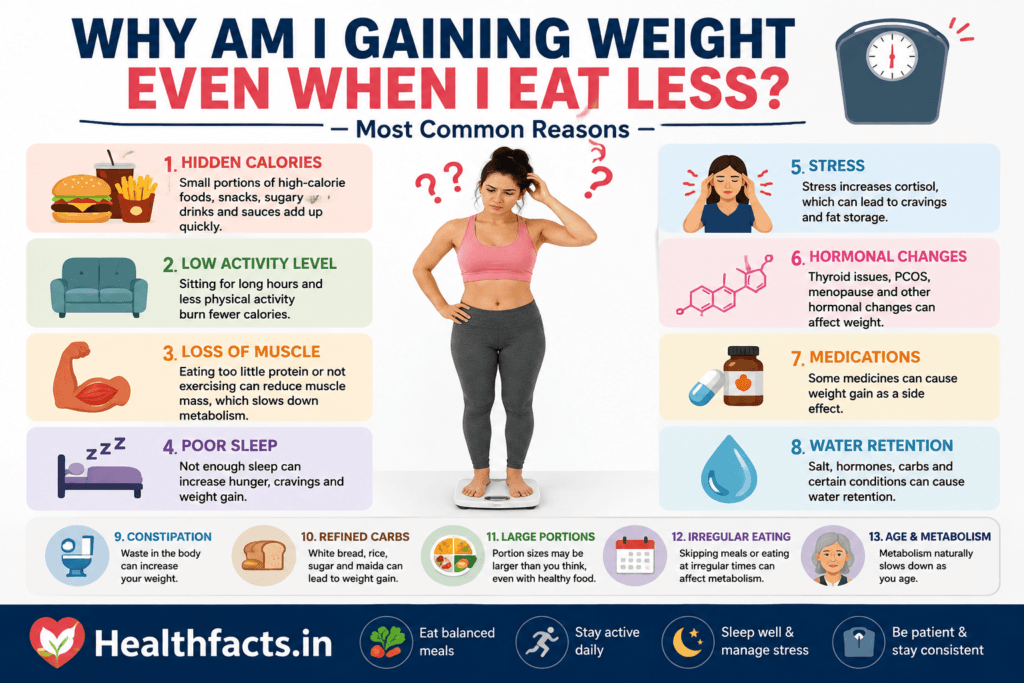
1. You May Be Eating Less, But Not Fewer Calories 🍔
One of the most common reasons is that food volume and calories are not the same thing.
You might eat small portions but choose foods that contain many calories.
For example:
- 🥜 A small handful of nuts can contain many calories.
- 🧈 Butter and cooking oil are calorie-dense.
- 🍰 A small piece of cake can contain a lot of calories.
- 🥤 Sugary drinks can add calories without making you feel full.
- 🍟 Fried foods can contain many calories in a small portion.
- ☕ Tea or coffee with sugar and cream can add calories throughout the day.
So, eating less food does not always mean eating fewer calories.
What can help?
Try focusing more on nutritious, filling foods such as:
- 🥦 Vegetables
- 🍎 Fruits
- 🫘 Beans and lentils
- 🥚 Eggs
- 🐟 Fish
- 🍗 Lean protein
- 🥛 Plain yogurt
- 🌾 Whole grains
📌 Also Read
2. You May Not Be Moving Enough 🚶
Your food intake is only one part of weight management.
Your body also burns calories through:
- Walking
- Exercise
- Household activities
- Standing
- Working
- Climbing stairs
- General daily movement
If you eat less but also move much less, your total calorie use may decrease.
For example, imagine you previously walked 8,000 steps every day but now walk only 3,000 steps.
Even if your meals have become smaller, your body may be burning fewer calories.
Try increasing daily movement:
- 🚶 Take short walks.
- 🪜 Use stairs when possible.
- 🧹 Do household activities.
- 🏃 Add regular exercise.
- 💻 Avoid sitting for very long periods.
- 🚶 Take a 10–15 minute walk after meals.
You don’t necessarily need a hard workout every day. Consistent daily movement matters.
3. Your Metabolism May Have Changed 🔥
Your metabolism is the process your body uses to produce and use energy.
As people get older, their energy needs can change. Muscle mass can also decrease if you are inactive.
Muscle uses more energy than fat tissue, so losing muscle can reduce the number of calories your body burns at rest.
This doesn’t mean your metabolism has suddenly “stopped.” Instead, your total energy needs may have changed.
What can help?
Try to:
- 🏋️ Include strength training.
- 🥚 Eat enough protein.
- 🚶 Stay physically active.
- 🛌 Get enough sleep.
- 🥗 Eat balanced meals.
Building or maintaining muscle can support a healthy metabolism.
4. You May Be Losing Muscle, Not Just Fat 💪
Sometimes people eat very little to lose weight.
But a very restrictive diet can cause loss of muscle and water, especially when protein intake and physical activity are low.
Later, when normal eating resumes, body weight can increase again.
This is one reason why extreme dieting is usually not a good long-term strategy.
Instead:
Focus on:
- 🍗 Adequate protein
- 🥗 Vegetables and fruits
- 🌾 High-fiber carbohydrates
- 🥑 Healthy fats
- 💧 Enough fluids
- 🏋️ Strength exercises
The goal should not simply be “eat as little as possible.”
The goal is to develop eating and activity habits that you can maintain.
5. Hidden Calories Can Add Up 🥤
Sometimes the biggest calorie sources are not obvious.
You may eat a small lunch and dinner but have several small extras during the day.
These can include:
- ☕ Sweetened tea or coffee
- 🥤 Soft drinks
- 🧃 Juice
- 🍪 Biscuits
- 🍫 Chocolate
- 🥜 Nuts
- 🍟 Snacks
- 🧈 Butter
- 🫒 Extra oil
- 🍯 Honey or sugar
- 🍨 Desserts
Each item may seem small.
But several small extras can add up over a day.
A useful habit
For a few days, write down everything you eat and drink, including cooking oil, sauces and snacks.
This can help you understand your actual eating pattern.
6. You May Be Eating Too Little Protein 🍳
Protein helps you feel full and is important for maintaining muscle.
If your meals are mostly refined carbohydrates and don’t contain much protein, you may become hungry again quickly.
Good protein sources include:
- 🥚 Eggs
- 🫘 Beans
- 🥣 Lentils
- 🐟 Fish
- 🍗 Chicken
- 🥛 Milk
- 🥛 Greek yogurt
- 🧀 Cottage cheese
- 🌱 Tofu
- 🫘 Soy foods
Try to include a protein source in your main meals.
7. Poor Sleep Can Affect Weight 😴
Sleep is often ignored when people are trying to lose weight.
When you don’t sleep well, you may:
- Feel more hungry
- Crave high-calorie foods
- Have less energy for exercise
- Move less during the day
- Find it harder to follow healthy eating habits
Poor sleep can also affect hormones involved in hunger and fullness.
Aim for good-quality sleep:
- 🛏️ Keep a regular bedtime.
- 📱 Reduce screen use before bed.
- ☕ Avoid too much caffeine late in the day.
- 🌙 Keep your bedroom comfortable and dark.
- ⏰ Try to maintain a consistent sleep schedule.
8. Stress Can Contribute to Weight Gain 😟
Stress affects your body in many ways.
When you are stressed, you may:
- Eat more snacks
- Crave sugary foods
- Sleep poorly
- Exercise less
- Eat emotionally
- Drink more calorie-containing beverages
Some people eat less when stressed, while others eat more.
Long-term stress can also affect hormones and appetite regulation.
Try simple stress-management activities:
- 🧘 Meditation
- 🚶 Walking
- 📖 Reading
- 🎵 Listening to music
- 🌳 Spending time outdoors
- 👨👩👧 Talking with family or friends
- 🫁 Deep breathing exercises
9. Water Retention Can Increase Your Weight 💧
Not every increase on the weighing scale means that you gained body fat.
Your body weight can change because of fluid retention.
You may temporarily weigh more after:
- Eating a salty meal 🧂
- Eating more carbohydrates
- Hormonal changes
- Traveling
- Hard exercise
- Certain medications
For example, your weight may increase by 1–2 kg over a short period without that amount being body fat.
That’s why:
Don’t judge your progress based on one day’s weight.
Instead:
📅 Weigh yourself under similar conditions and look at the trend over several weeks.
10. Constipation Can Affect the Scale 🚽
If you are constipated, the contents of your digestive system can temporarily increase your weight.
Constipation may be more likely when you:
- Eat very little fiber
- Drink too little fluid
- Don’t move enough
- Suddenly change your diet
Increase fiber gradually through:
- 🍎 Apples
- 🍐 Pears
- 🥕 Vegetables
- 🫘 Beans
- 🌾 Whole grains
- 🌱 Seeds
- 🍓 Berries
Also drink enough water and stay physically active.
11. Hormonal Changes May Play a Role ⚖️
Hormones can influence appetite, metabolism, fluid balance and body weight.
For example, some people can gain weight when they develop certain hormonal conditions.
One example is underactive thyroid (hypothyroidism).
Possible symptoms can include:
- 😴 Tiredness
- 🥶 Feeling unusually cold
- 🧴 Dry skin
- 💇 Hair changes
- 🚽 Constipation
- ⚖️ Weight gain
However, these symptoms can have many causes.
If you are gaining weight without a clear reason, especially along with other symptoms, talk with a healthcare professional.
2. What Should You Do If You are Gaining Weight? ✅
Instead of eating less and less, try a balanced approach.
Step 1: Look at your food 🍽️
Ask yourself:
- Am I drinking sugary beverages?
- Am I eating frequent snacks?
- How much cooking oil do I use?
- Are my portions larger than I realize?
- Do I eat when I’m stressed or bored?
Step 2: Increase protein 🍳
Include protein with your meals.
Step 3: Eat more fiber 🥦
Choose vegetables, fruits, beans and whole grains.
Step 4: Move more 🚶
Try to increase your daily walking and physical activity.
Step 5: Add strength training 🏋️
Strength exercises can help maintain and build muscle.
Step 6: Improve sleep 😴
Aim for a regular and sufficient sleep schedule.
Step 7: Manage stress 🧘
Find activities that help you relax.
Step 8: Track your progress 📈
Look at your weight trend rather than one day’s number
3. Simple Weight-Loss Plate 🥗
A simple way to build your meals is:
🥦 ½ plate: Vegetables and salad
🍗 ¼ plate: Protein such as eggs, chicken, fish, beans, dal or tofu
🍚 ¼ plate: Rice, roti, potatoes or another whole-food carbohydrate
Add a small amount of healthy fat such as nuts, seeds or healthy cooking oils.
You don’t need to completely remove carbohydrates to lose weight.
What NOT to Do ❌
Avoid extreme methods such as:
- ❌ Starving yourself
- ❌ Skipping food all day
- ❌ Eating only one type of food
- ❌ Using unproven weight-loss pills
- ❌ Following crash diets
- ❌ Completely eliminating carbohydrates without a medical reason
- ❌ Exercising excessively to compensate for food
These approaches may be difficult to maintain and can sometimes cause nutritional problems.
4. When Should You See a Doctor? 🩺
Talk to a healthcare professional if you have unexplained or rapid weight gain, especially if it happens along with other symptoms.
Seek medical advice if you notice:
- ⚠️ Significant unexplained weight gain
- 🦵 Swelling in your legs or feet
- 😮 Shortness of breath
- 😴 Severe tiredness
- 🥶 Unusual sensitivity to cold
- 💓 Other new or concerning symptoms
- 💊 Weight gain after starting a new medicine
A doctor can review your symptoms, medicines, lifestyle and medical history and decide whether testing is needed.
Frequently Asked Questions ❓
1. Why am I gaining weight if I eat very little?
There can be several reasons. You may be consuming more calories than you realize, moving less, sleeping poorly, retaining water, losing muscle, or experiencing hormonal or medication-related changes.
2. Can eating too little cause weight gain?
Eating too little does not normally make body fat increase by itself. However, very restrictive diets can reduce activity and muscle mass and can make it harder to maintain healthy eating habits. Weight can also fluctuate because of water and digestive contents.
3. Why am I gaining weight but not eating more?
Weight can increase temporarily because of water retention, constipation, hormonal changes, changes in activity, or other factors. Look at your weight trend over several weeks rather than one measurement.
4. Does slow metabolism cause weight gain?
A lower energy requirement can contribute to weight gain, particularly when activity and muscle mass decrease. However, “slow metabolism” is only one possible factor.
5. Can stress cause weight gain?
Yes. Stress can affect sleep, appetite, food choices and physical activity. Some people eat more when stressed, especially high-calorie comfort foods.
6. Can lack of sleep cause weight gain?
Poor sleep can affect hunger, cravings, energy and activity. Improving sleep may make healthy weight management easier.
7. Should I eat even less to lose weight?
Not necessarily. Eating extremely little is usually not the best strategy. Focus on balanced meals, appropriate portions, protein, fiber and regular physical activity.
8. How long does it take to lose weight?
It varies from person to person. A gradual approach is generally easier to maintain than rapid weight loss.
5. Final Takeaway 📝
“I eat less, but I’m still gaining weight” can happen for many reasons.
Your weight is affected by much more than the amount of food on your plate.
The main factors can include:
- 🍽️ Food choices and portion sizes
- 🚶 Daily physical activity
- 💪 Muscle mass
- 😴 Sleep
- 😟 Stress
- 💧 Water retention
- 🚽 Constipation
- ⚖️ Hormonal changes
- 💊 Certain medicines
- 🎂 Age-related changes
The best approach is usually not to keep eating less and less. Instead, focus on nutritious foods, enough protein and fiber, regular movement, strength training, good sleep and sustainable habits.
And remember: one increase on the weighing scale does not automatically mean you gained body fat. Look at the bigger picture and the trend over time. ❤️
The information provided on Healthfacts.in is for general educational and informational purposes only. It is not a substitute for professional medical advice, diagnosis, or treatment.
Always consult a qualified healthcare professional before making any decisions regarding your health, medication, diet, supplements, or treatment.

Hi, I’m Shishpa, founder of Healthfacts.in. I am a passionate health blogger focused on Mental wellness, Diabetes care, Weight management, and natural remedies. My goal is to provide easy, research-based and practical health advice that anyone can follow at home.