
ADHD: Early Signs, Symptoms, Causes, Types & Treatment Options
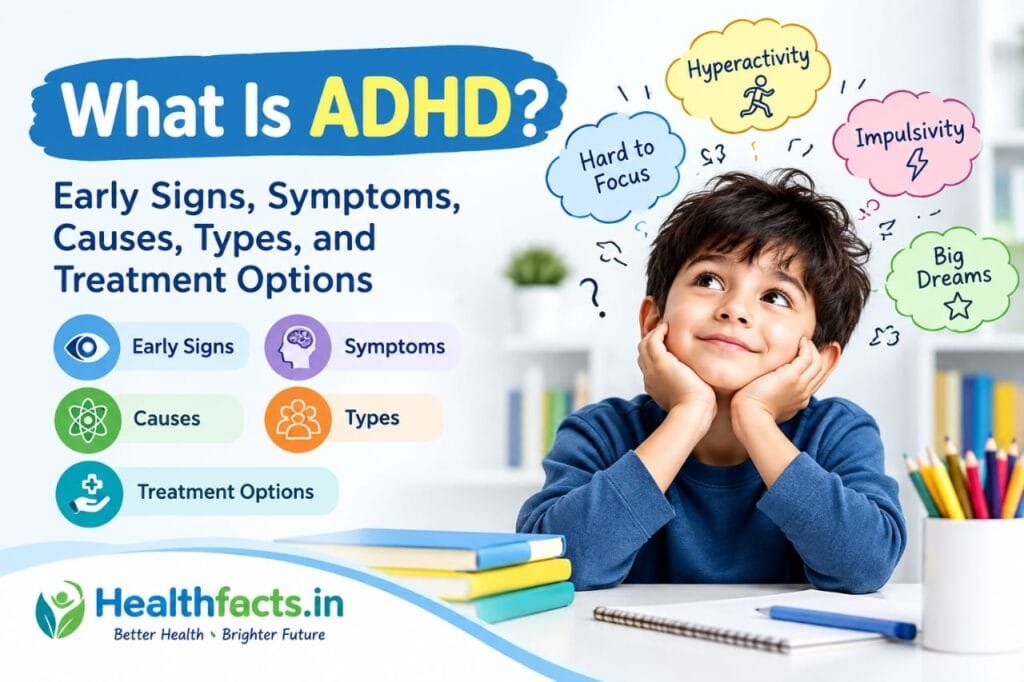
ADHD (Attention-Deficit/Hyperactivity Disorder) is a common neurodevelopmental disorder that can affect attention, activity level, impulse control, organization, and everyday functioning. It often begins in childhood, but symptoms can continue into adolescence and adulthood.
ADHD is more than simply being distracted or energetic. The symptoms are usually persistent and can interfere with school, work, relationships, family life, and daily responsibilities.
In this article, we explain ADHD in simple language, including its early signs, symptoms, causes, types, diagnosis, and treatment options.”.
ADHD Signs, symptoms, causes, types, diagnosis, and treatment options may vary from person to person.
1. 🧠 What Is ADHD?
ADHD, or Attention-Deficit/Hyperactivity Disorder, is a neurodevelopmental disorder that can affect both children and adults. It is commonly associated with difficulties with attention and focus, along with symptoms such as hyperactivity and impulsive behavior.
It is important to understand that everyone can become distracted or forgetful sometimes. These normal experiences do not automatically mean that someone has ADHD.
ADHD may be a concern when symptoms:
- Continue for a long time
- Happen in more than one part of life, such as school, work, or home
- Cause problems with daily life
📌 Also Read
2. 🚩 Early Signs of ADHD
The early signs of ADHD can often become noticeable during childhood.
However, children naturally have different personalities and energy levels. Some children are naturally active, talkative, or easily distracted. Therefore, one or two behaviors are not enough to identify ADHD.
Parents and teachers may notice a repeated pattern of behaviors such as:
- 🧠 Difficulty paying attention
- 👀 Becoming distracted easily
- 📚 Trouble completing homework
- 📝 Making careless mistakes
- 🎒 Frequently losing school items
- ⏰ Forgetting instructions
- 🪑 Difficulty staying seated
- 🗣️ Talking excessively
- ✋ Interrupting other people
- ⏳ Difficulty waiting
- ⚡ Acting without thinking
- 🔄 Moving from one activity to another quickly
👧 Early Signs in Children
ADHD can sometimes become noticeable when a child starts school because school requires children to sit, listen, remember instructions, complete assignments, and organize their belongings.
Possible signs include:
- Frequently forgetting homework
- Losing pencils, books, or toys
- Difficulty following multi-step instructions
- Frequently getting out of their seat
- Interrupting teachers or classmates
- Difficulty waiting in line
- Becoming distracted during lessons
- Having trouble finishing assignments
- Frequently changing activities
- Making mistakes because of poor attention
Some children with ADHD may not be especially hyperactive. Instead, they may appear quiet, forgetful, dreamy, or easily distracted.
🧑 Early Signs in Children in Adults
- Difficulty managing time
- Forgetting appointments
- Trouble organizing work
- Procrastination
- Difficulty staying focused
- Restlessness
- Impulsive decisions
- Problems completing tasks
3. 🔍 Common Symptoms of ADHD
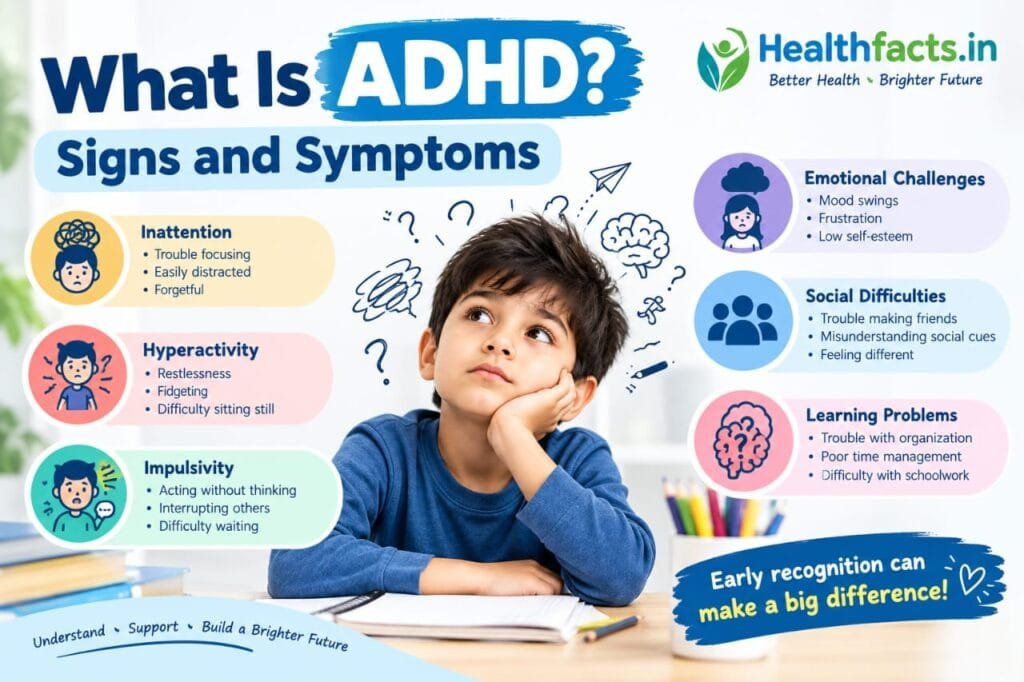
ADHD symptoms are generally grouped into three areas:
- Inattention
- Hyperactivity
- Impulsivity
Not everyone with ADHD experiences the same symptoms.
One person may mainly struggle with concentration, while another may be very restless and impulsive. Some people experience symptoms from all three areas.
🧠 Symptoms of Inattention
Inattention means having difficulty maintaining and controlling attention when needed.
Common symptoms include:
- Easily becoming distracted
- Difficulty concentrating
- Forgetting daily activities
- Frequently losing things
- Difficulty organizing tasks
- Trouble following instructions
- Avoiding tasks that require long periods of concentration
- Making careless mistakes
- Forgetting appointments or deadlines
- Appearing not to listen when spoken to
Starting tasks but not finishing them
⚡ Symptoms of Hyperactivity
Hyperactivity means having difficulty controlling excessive movement or restlessness.
In children, it may appear as:
- 🪑 Constantly getting up
- 🏃 Running or climbing when inappropriate
- 🤸 Fidgeting frequently
- 🗣️ Talking excessively
- 🔊 Difficulty participating quietly
- 🚀 Acting as if they are constantly “on the go”
In adults, hyperactivity may be less obvious.
It can feel more like:
- Internal restlessness
- Difficulty relaxing
- Constant movement
- Feeling uncomfortable sitting for a long time
- Talking excessively
🚀 Symptoms of Impulsivity
Impulsivity means acting quickly without thinking sufficiently about the consequences.
Common examples include:
- Interrupting conversations
- Answering before a question is finished
- Difficulty waiting for a turn
- Making quick decisions
- Acting without considering consequences
- Interrupting other people’s activities
- Saying things without thinking
Impulsivity can sometimes create problems at school, work, home, or in relationships.
4. 📋 Types of ADHD
There are three main presentations of ADHD:
1. Predominantly Inattentive Presentation
The main difficulties involve:
- Attention
- Memory
- Organization
- Completing tasks
- Following instructions
- Avoiding distractions
A person may appear quiet and well-behaved while still experiencing significant attention problems.
2. Predominantly Hyperactive-Impulsive Presentation
The main difficulties involve:
- Excessive activity
- Restlessness
- Fidgeting
- Interrupting
- Difficulty waiting
- Acting impulsively
3. Combined Presentation
A person has significant symptoms related to both:
- Inattention
- Hyperactivity and impulsivity
The presentation can change over time as symptoms and life demands change.
5. 🧬 What Causes ADHD?
There is no single cause of ADHD.
Research suggests that ADHD is influenced by a combination of genetic, biological, developmental, and environmental factors.
Genetics appear to play an important role. ADHD can occur in multiple members of the same family, although having a family member with ADHD does not mean that another person will definitely develop it.
Researchers are also studying differences in brain development and brain function in people with ADHD.
Some factors associated with ADHD risk include:
- 🧬 Family history and genetic factors
- 🧠 Differences in brain development
- 👶 Certain factors during pregnancy or early development
- 🌍 Certain environmental influences
The exact combination of factors can differ between individuals.
6. ❌ What Does NOT Cause ADHD?
Several myths about ADHD are common.
ADHD is not simply caused by:
- Poor parenting
- Laziness
- Lack of discipline
- Lack of intelligence
- Being addicted to technology
- A child simply being “naughty”
Parents can influence how a child manages ADHD symptoms, but poor parenting does not cause ADHD.
Likewise, ADHD does not mean that someone is less intelligent.
People with ADHD can have many strengths, including:
- 💡 Creativity
- ⚡ Energy
- 🎨 Imagination
- 🧩 Problem-solving ability
- ❤️ Enthusiasm
- 🚀 Strong interest in subjects they enjoy
7. 🩺 How Is ADHD Diagnosed?
There is no single test for ADHD.
A healthcare professional usually performs a detailed assessment.
The assessment may consider:
- Current symptoms
- Childhood history
- School performance
- Work performance
- Behavior at home
- Relationships
- Duration of symptoms
- The effect of symptoms on daily life
- Other possible health conditions
For children, parents and teachers may provide useful information about behavior.
Doctors may also use standardized questionnaires or rating scales as part of the assessment.
8. 💊 ADHD Treatment Options
ADHD treatment is individualized.
There is no single treatment that works exactly the same way for everyone.
Depending on the person’s age and needs, treatment may include:
- 💊 Medication
- 🧠 Behavioral therapy
- 👨👩👧 Parent training
- 🏫 School support
- 🗂️ Organizational strategies
- 🗣️ Psychotherapy
- 🌿 Healthy lifestyle habits
Treatment aims to improve daily functioning and quality of life, not simply make someone less active.
💊 Medication for ADHD
Medication can help reduce ADHD symptoms for many people.
Common medication approaches include:
- Stimulant medications
- Non-stimulant medications
The appropriate medicine depends on the individual.
Possible side effects can occur, so medication should be prescribed and monitored by a qualified healthcare professional.
Never start, stop, or change ADHD medication without medical advice.
🧠 Behavioral Therapy
Behavioral approaches can help children and adults develop practical skills.
They may focus on:
- Improving organization
- Creating routines
- Managing impulsive behavior
- Completing tasks
- Managing time
- Improving communication
- Reinforcing positive behaviors
For younger children, parent training can be particularly useful because parents can learn practical ways to support behavior and routines at home.
🏫 School Support for Children With ADHD
Children with ADHD may benefit from appropriate educational support.
Helpful strategies can include:
- 📋 Giving clear instructions
- 📝 Breaking large assignments into smaller tasks
- ⏰ Using reminders
- 🎯 Reducing unnecessary distractions
- 📚 Providing organizational support
- 👩🏫 Communicating regularly with parents and teachers
The exact support should be based on the child’s individual needs.
🌿 Lifestyle Strategies That May Help
Healthy habits do not replace professional ADHD treatment, but they can support overall health and daily functioning.
Useful strategies include:
- 💤 Maintain a consistent sleep schedule
- 🚶 Get regular physical activity
- 🥗 Eat a balanced diet
- 📅 Follow a predictable daily routine
- 📝 Use checklists
- ⏰ Set reminders and alarms
- 📱 Reduce unnecessary distractions
- 🎯 Break large tasks into smaller steps
- 🤝 Ask family members or professionals for support
For many people, external systems work better than relying only on memory.
For example, instead of trying to remember every appointment, use a calendar and automatic reminder.
Having a few ADHD like symptoms does not necessarily mean you have ADHD. A qualified healthcare professional should evaluate persistent symptoms and consider other possible causes.
9.🚨 When Should You Talk to a Doctor?
Consider seeking professional advice when attention, hyperactivity, impulsivity, or organizational difficulties:
- Continue over time
- Affect school performance
- Affect work
- Cause problems at home
- Affect relationships
- Make daily responsibilities difficult
- Cause significant distress
- Are difficult to manage despite reasonable support
For children, parents can begin by discussing concerns with a pediatrician or other qualified healthcare professional.
Adults can also seek an ADHD evaluation if long-term symptoms are affecting work, relationships, or daily life.
10.📝 Final Thought
ADHD is a neurodevelopmental disorder that affects attention, activity level, impulse control, and everyday functioning. It commonly begins during childhood but can continue into adulthood. The three main ADHD presentations are predominantly inattentive, predominantly hyperactive-impulsive, and combined presentation.
Early recognition can be helpful because untreated difficulties may affect school, work, relationships, and confidence. At the same time, having occasional problems with attention or restlessness does not mean someone has ADHD.
Treatment can include medication, behavioral therapy, parent training, school support, organizational strategies, and healthy lifestyle habits. The right approach depends on the individual’s age, symptoms, needs, and circumstances.
If you suspect that you or your child may have ADHD, speak with a qualified healthcare professional rather than relying on an online test or self-diagnosis. With the right understanding and support, ADHD can be managed, and people with ADHD can build successful and fulfilling lives.
FAQs❓
1. What is ADHD in simple words?
ADHD is a condition that can make it difficult to pay attention, control impulses, stay organized, or manage activity levels. It can affect both children and adults.
2. What are the early signs of ADHD?
Early signs may include easily becoming distracted, forgetting things, losing belongings, difficulty completing tasks, excessive activity, interrupting others, and acting without thinking.
3. What are the three types of ADHD?
The three presentations are:
- Predominantly inattentive
- Predominantly hyperactive-impulsive
- Combined presentation
4. Can adults have ADHD?
Yes. ADHD can continue into adulthood. Adults may experience problems with concentration, organization, time management, forgetfulness, restlessness, and impulsive behavior.
5. Can ADHD be treated?
Yes. Treatment may include medication, behavioral therapy, parent training, school support, psychotherapy, and practical organizational strategies. The best treatment depends on the individual.
The information provided on Healthfacts.in is for general educational and informational purposes only. It is not a substitute for professional medical advice, diagnosis, or treatment.
Always consult a qualified healthcare professional before making any decisions regarding your health, medication, diet, supplements, or treatment.

Hi, I’m Shishpa, founder of Healthfacts.in. I am a passionate health blogger focused on Mental wellness, Diabetes care, Weight management, and natural remedies. My goal is to provide easy, research-based and practical health advice that anyone can follow at home.